create a glossary from page 361 from your book "Heat Transfer"
Convection heat transfer coefficient
noun
The convective heat transfer coefficient, h, can be defined as:
The rate of heat transfer between a solid surface and a fluid per unit surface area per unit temperature difference.
Example: The convective heat transfer coefficient is dependent upon the physical properties of the fluid and the physical situation. The convective heat transfer coefficient is not a property of the fluid.
es: Coeficiente de transferencia de calor por convección
Critical Reynold’s number
noun
Critical-reynolds-number meaning
A Reynolds number at which the flow of a fluid changes from laminar to turbulent.
Example: The Reynolds number is the ratio of inertial forces to viscous forces and is a convenient parameter for predicting if a flow condition will be laminar or turbulent.
es: Número crítico de Reynolds
Friction Coefficient
noun
The coefficient of friction or coefficient of friction links the opposition to sliding offered by the surfaces of two bodies in contact according to the intensity of the mutual support they experience.
Example: Disc brake performance has shown to be dependant upon the geometry of the disc and pads, and the FRICTION COEFFICIENT between the pad material and the rotor.
es: Coeficiente de fricción
Kinematic viscosity
noun
The kinematic viscosity is an atmospheric variable defined as the ratio between the dynamic viscosity μ and the density ρ of the fluid, i.e.
and depends on both air temperature and pressure.
Example: This is not as intuitive as absolute viscosity as it would appear, take air as an example which under standard conditions has a higher KINEMATIC VISCOSITY than water owing to its lower density.
es: Viscosidad cinemática
Laminar flow
noun
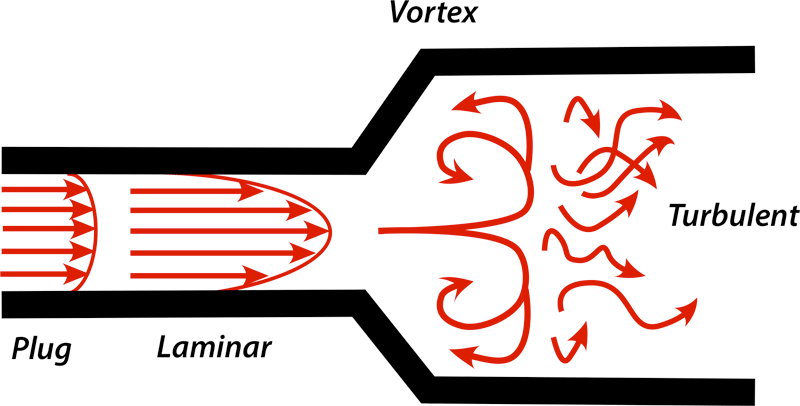
Laminar flow or laminar current is called the movement of a fluid when it is ordered, stratified or smooth.
Example: This gap size ensures that only LAMINAR FLOW is present in the space between the disks.
es: Flujo laminar
Nusselt number
noun
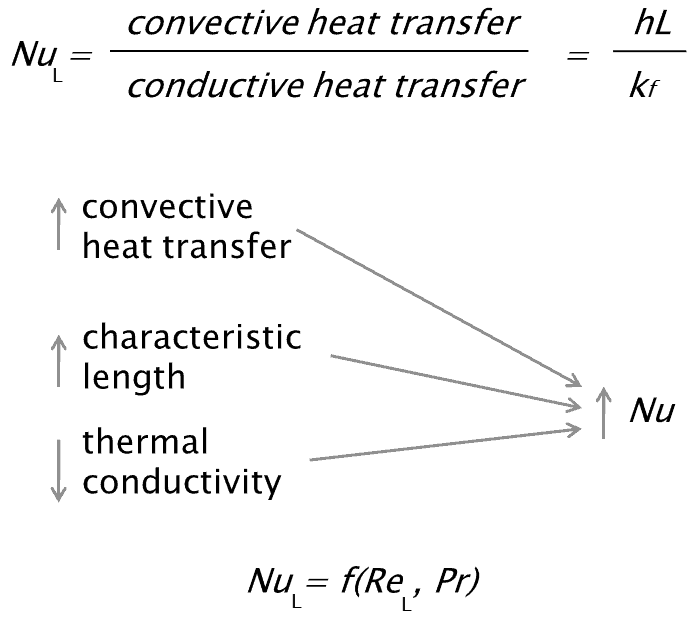
The Nusselt number is a dimensionless number that measures the increase in heat transfer from a surface through which a fluid passes compared to the heat transfer if it occurred only by conduction.
Example: Nusselt number is an important parameter that can contribute to a better rate of heat exchange.
es: Número de Nusselt
Prandtl number
noun
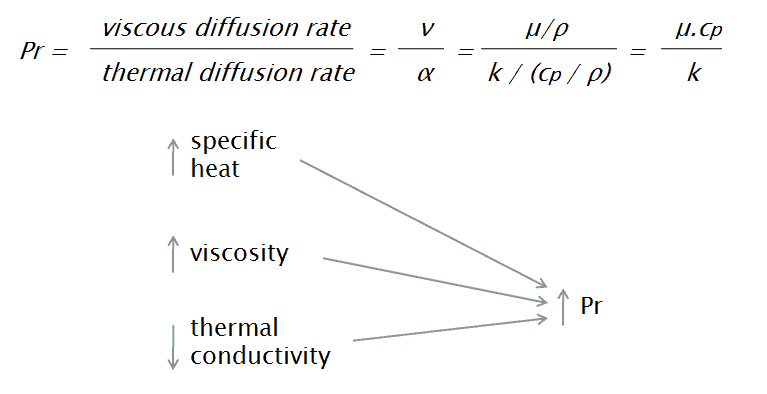
The Prandtl number is a dimensionless number proportional to the quotient between the diffusion rate of the moment quantity and the thermal diffusivity.
Example: The Prandtl number is a dimensionless quantity that puts the viscosity of a fluid in correlation with the thermal conductivity. It therefore assesses the relation between momentum transport and thermal transport capacity of a fluid.
es: Número de prandtl
Reynold number
noun
The Reynolds number is a dimensionless number used in fluid mechanics, reactor design, and transport phenomena to characterize the motion of a fluid.
Example: Its value indicates whether the flow follows a laminar or turbulent pattern.
es: Número de Reynold
Shear stress
noun
Shear stress, force tending to cause deformation of a material by slippage along a plane or planes parallel to the imposed stress.
Example: In order for the fluid to deform in this manner a SHEAR STRESS, , has to present, this SHEAR STRESS is the fluids viscosity, which in SI units are Ns m 2 .
es: Esfuerzo cortante
Turbulent flow
noun
Turbulent flow, type of fluid (gas or liquid) flow in which the fluid undergoes irregular fluctuations, or mixing, in contrast to laminar flow, in which the fluid moves in smooth paths or layers.
Example: TURBULENT FLOW is dominated by inertial forces and produces random eddies.